What makes a brand system agentic.
Most brand systems were written for people. More of the work is now done by agents, and they read a brand in a different way from the people it was written for.
The landing page, the follow-up email, the support reply and the social post are increasingly drafted by an agent before a person sees them. Some are never seen by a person at all.
Each of those agents is working from some idea of your brand. The question is where that idea comes from, and whether it is the one you approved.
1. Guidelines were written to be interpreted
A brand guideline says the voice is confident but never arrogant, or that the red is used sparingly. A designer who has worked on the brand for a year knows what that means, because they have seen a hundred examples and been corrected on a dozen.
An agent has not. It reads the sentence as text and fills the gap with the average of everything it has seen described that way.
The result is plausible, close to the tone and slightly wrong. Multiply that by every agent and every channel, and the brand drifts without anyone deciding that it should.
2. What agentic means here
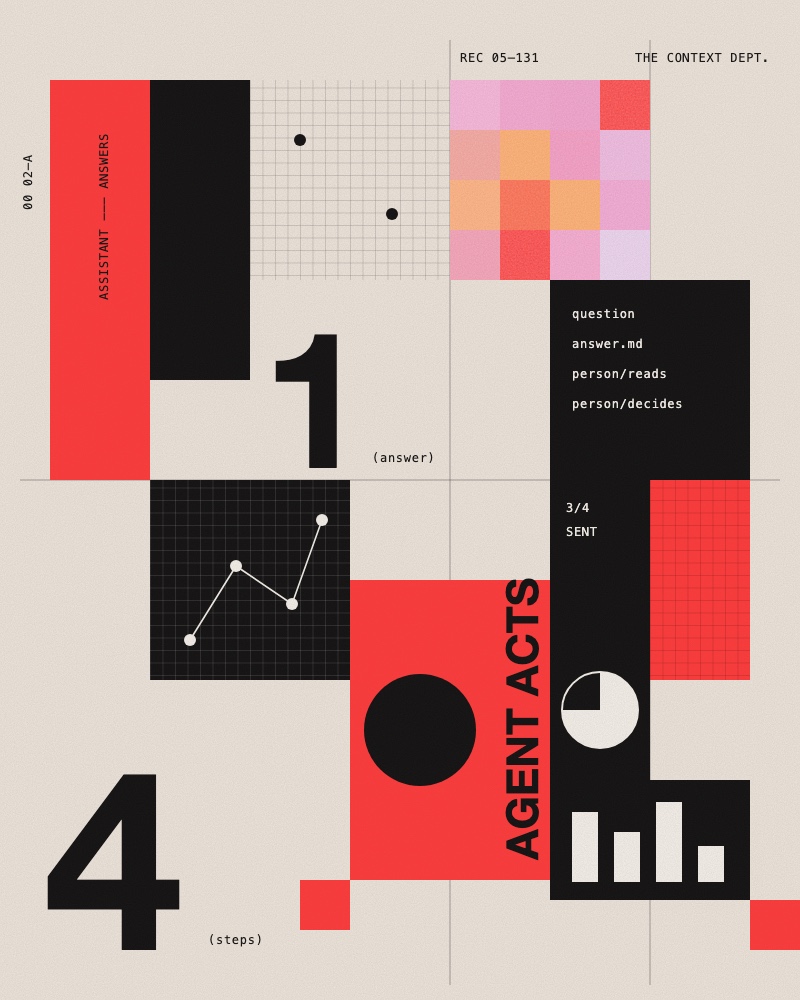
An agentic brand system is one written for the agents that act on it. They read it directly every time they work, and it tells them what to do as well as what to look like.
How an agentic brand system works
DiagramThree things set it apart from a guideline:
- It is data, not description. A colour is a value, a product name is a string, and a claim is a sentence with its conditions attached.
- It is read at the moment of work, not learnt once. An agent opens the current version each time, so nothing it remembers from last month outranks what is true today.
- It holds rules for behaviour as well as appearance: what an agent may say, what it must refuse and who it hands the question to.
3. What goes in it
The contents are familiar to anyone who has written a guideline. The difference is that each part is written precisely enough for a machine to apply without guessing.
- Values. Colour, type, spacing and components as exact values, so every tool renders the same red.
- Words. Voice as examples and counter-examples rather than adjectives, and terminology with retired names marked as retired.
- Claims. Each approved claim in its exact wording, with the evidence behind it, the conditions that must travel with it and the person who approved it.
- Behaviour. Which questions an agent may answer, which it must refuse, and the named person it passes the rest to.
- History. Every change with a date and a reason, so anyone can see what the brand said on a given day and why it changed.
4. One source, many readers
Most companies already have several agents, and each tends to read whatever it was pointed at when someone set it up. The content agent reads the deck, the sales assistant reads old call notes, and the support agent reads the help centre.
Versions of the same product description in use at a sample company, by tool
Illustrative · sample brandNone of those agents is broken; each is faithful to what it was given. An agentic brand system fixes the cause rather than the symptoms, by giving every agent the same source to read.
5. Refusing is part of the system
A guideline never had to say what to do when the answer is not in it, because a person would ask. An agent will not ask unless it is told to, and an agent with nothing to go on will usually improvise.
So the system says it plainly. If a claim is not in the record, the agent does not make it; if a question is outside what it may answer, it hands the question to a named person.
That is not a limit on what the agent can do. It is the reason you can let it work without reading everything it writes.
6. Change it once
When a brand changes under a guideline, someone issues a new PDF and the old version lingers for a year in decks, templates and prompts. When it changes in a system, it changes once, and every agent reads the new version the next time it works.
Changes are proposed, reviewed and approved like code, each with a reason attached. A year later, anyone can see not only what changed but who agreed to it and why.
7. Where to start
Not with the agents. Start with what the tools already say about you, because that shows where the brand is being guessed at and which gaps the system has to fill first.
Start with the audit. It is free, it is one pass, and you keep what it finds whether or not anything follows it.